
Passive Acoustic UAS Detection for Integrated Counter-UAS Operations

Scott Fournier
Sales Manager | Team Leadership | Business & GTM Strategy
Executive Summary
Small unmanned aircraft systems (UAS) are a persistent threat to maneuver formations, command posts, logistics nodes, critical infrastructure, firing positions, and other high-value assets. Integrated counter-UAS (C-UAS) architectures therefore combine multiple sensing and defeat technologies, including radio-frequency (RF) detection, radar, electro-optical/infrared (EO/IR), electronic warfare, and kinetic or non-kinetic effectors. The continued evolution of the threat is creating gaps within those architectures, particularly when UAS reduce or eliminate the RF emissions normally used for detection or attack.
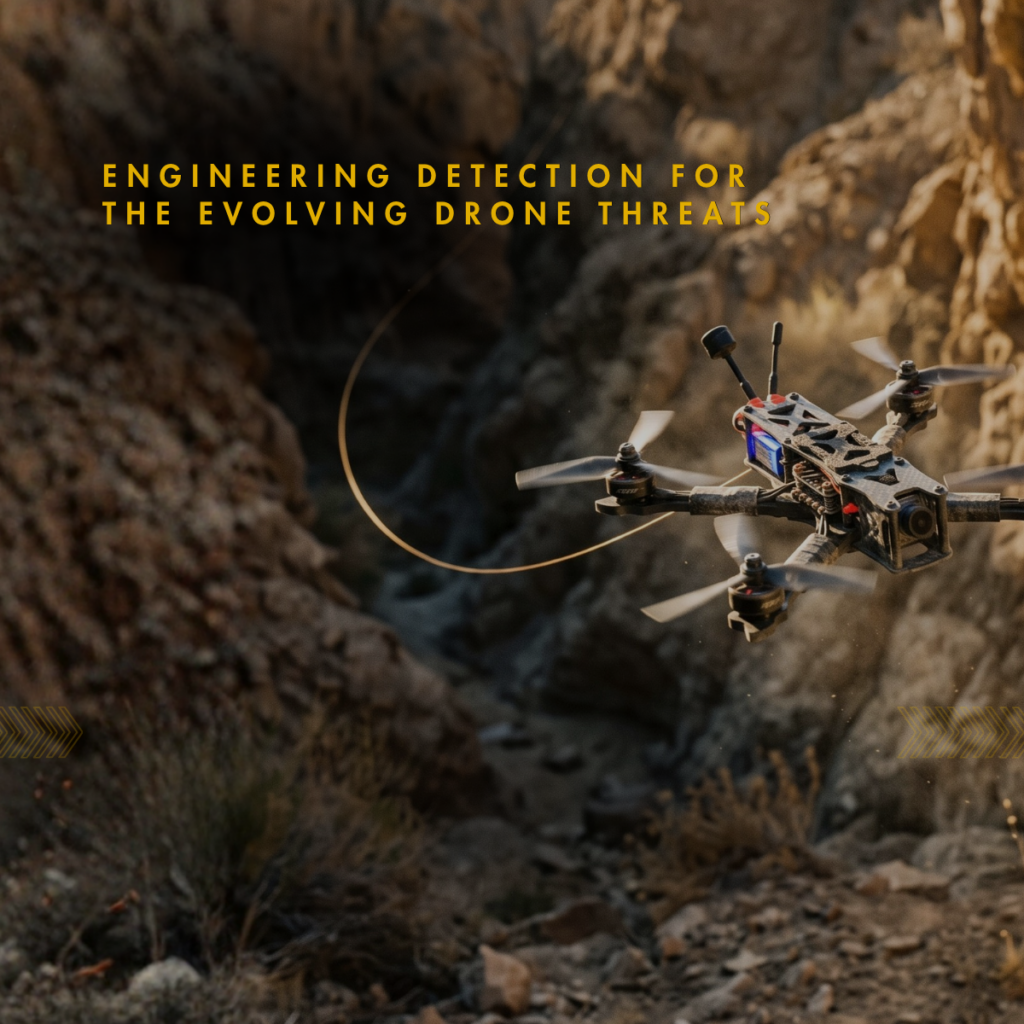
Fiber-optic-controlled UAS illustrate the problem directly. Replacing the conventional RF command, control, and video link with a physical fiber-optic connection removes the control-link emissions normally exploited by RF detection, direction finding, jamming, and spoofing. Autonomous and pre-programmed UAS can create a similar challenge by operating without a persistent external control link. These aircraft are not physically invisible, but an established detection and electronic-attack layer may be absent or significantly reduced.
Acoustic sensing addresses that gap through a physically independent modality. Motors, rotors, propellers, and aerodynamic activity continue to create acoustic signatures regardless of how the aircraft is controlled. McQ’s passive acoustic technology supports two complementary employment models: the current hand-emplaced RANGER® Enhanced UGS, which can be used as a persistent sensor picket, and a developmental Body-Worn Acoustic RANGER® concept that moves passive detection with dismounted forces.
In both models, the principal operational value is early warning, classification, correlation, and cueing rather than fire-control-quality tracking. RANGER® detections can reduce the search problem for complementary sensors by providing a probable threat event and, where the configuration supports it, bearing, sector, movement, or location information. Radar or EO/IR can then confirm and track the target for the larger C-UAS architecture. Acoustic sensing is therefore not a replacement for existing C-UAS components; it is an additional detection opportunity that remains relevant when the aircraft provides little or no exploitable RF signature.
Operational Context and Problem
The proliferation of Group 1-3 and first-person-view UAS has compressed the force-protection timeline. Small aircraft can conduct reconnaissance, targeting, one-way attack, munition delivery, and battle-damage assessment while flying at low altitude and exploiting terrain, vegetation, structures, and clutter. Integrated C-UAS systems respond through layered sensing because each modality observes the threat through a different physical mechanism and has different tactical limitations.
Fiber-optic control removes a conventional RF warning and electronic-attack opportunity without removing the aircraft’s radar, visual, or acoustic signatures. Autonomous navigation, pre-programmed routes, onboard processing, intermittent communications, and other increasingly independent behaviors can create the same underlying problem: a defensive architecture that depends too heavily on the control link may receive less useful information or none at all. The enduring requirement is therefore broader than fiber-optic UAS. Forces need ways to detect RF-independent or reduced-RF-signature aircraft by sensing the aircraft itself.
This matters because the remaining detection timeline may already be short. A small UAS can fly very low, approach through masked terrain or vegetation, and present only seconds for classification and response once visually observed. Acoustic sensing adds another opportunity to detect the physical aircraft before that point. Its purpose is not to solve the complete detection-to-engagement chain independently, but to restore decision time by providing an earlier indication that can be fused with the rest of the C-UAS architecture.
Tactical Employment Requirement
An integrated C-UAS architecture must detect a threat early enough to support classification, confirmation, tracking, decision, and defeat. No single sensor should be assumed to perform every element. RF detection can be highly effective when a UAS is transmitting. Radar can provide range and track information but may be challenged by very small targets, low-altitude flight, terrain masking, structures, and clutter. EO/IR can provide high-confidence visual confirmation but generally requires line of sight and must be oriented toward the area in which the target is expected to appear.
Acoustic sensing extends this layered approach in two ways. Hand-emplaced RANGER® Enhanced UGS nodes can remain in selected terrain as a persistent passive sensor picket. A developmental Body-Worn Acoustic RANGER® can instead move with a squad or patrol where prior emplacement is impractical or where the force has moved beyond a fixed sensor perimeter. Both concepts are intended to convert acoustic activity into event information rather than requiring an operator to monitor raw audio.
The key requirement is actionable cueing. A probable UAS classification, bearing, sector, or sequence of detections can reduce the volume of airspace that radar, EO/IR, operators, or other C-UAS components must search. The acoustic layer therefore improves the larger kill chain when it provides reliable information early enough for complementary sensors and operators to act.
RANGER® Acoustic UAS Detection: Two Employment Models
McQ’s passive acoustic UAS technology supports a persistent hand-emplaced sensing mission and a mobile body-worn sensing mission. The two concepts address different coverage problems and are complementary rather than competing approaches.
Hand-Emplaced Sensor Picket – RANGER® Enhanced UGS
RANGER® Enhanced UGS is McQ’s current hand-emplaced unattended ground sensor for passive detection and classification. Each node combines acoustic, seismic, and magnetic sensing with tamper protection in a compact IP67 / MIL-STD-810 enclosure and uses internal rechargeable power for persistent unattended operation. For C-UAS employment, multiple sensors can be positioned around defended assets, tactical positions, likely low-altitude approaches, terrain gaps, or other locations where distributed passive sensing provides additional warning time.
The current technical capability basis supports acoustic detection of Group 1-3 UAS and reports greater than 350 meters of demonstrated acoustic UAS detection under tested conditions. That figure is a planning reference rather than a universal tactical radius. Actual performance varies with aircraft signature, ambient noise, terrain, vegetation, weather, emplacement, and the operating environment. RANGER® reports classified detection events rather than requiring continuous transmission or monitoring of raw acoustic data.
Body-Worn / Dismounted Operations – Developmental RANGER® Concept
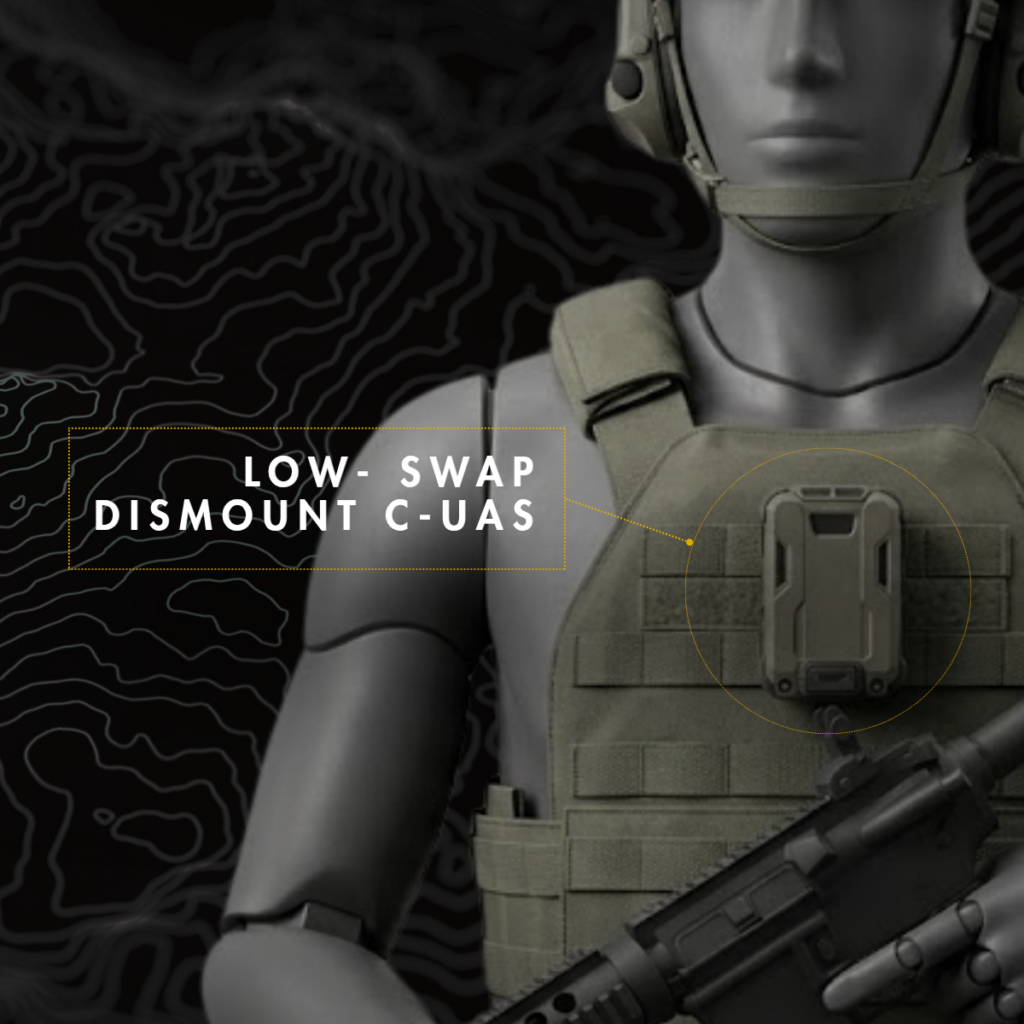
The Body-Worn Acoustic RANGER® concept applies the same passive acoustic technology foundation to a low-SWaP, acoustic-only sensor for dismounted and squad C-UAS operations. The intent is to carry detection with the force, perform detection, classification, and bearing processing at the sensor, and deliver event information directly to the user’s end-user device (EUD) for local warning and distribution through the user’s existing tactical network.
The concept is intended to require minimal user interaction and to support machine-to-machine cueing through CoT, JSON, XML, or third-party API interfaces. It carries forward the acoustic array approach, UAS algorithms, edge processing, bearing estimation, low-power embedded architecture, and integration experience developed through the existing RANGER® technology base. Developmental work remains focused on the new form factor, microphone and mounting geometry, wearer movement and self-noise, EUD power and data integration, environmental characterization, and user interaction. Body-worn performance should therefore not be assumed to equal the hand-emplaced RANGER® Enhanced UGS until representative testing is complete.
Role Within an Integrated C-UAS Architecture
RANGER® acoustic sensing is best employed as an independent detection and cueing layer that contributes to a common threat picture. Its value derives from several characteristics working together.
Control-Link Independence and Passive Detection
Acoustic sensing detects the physical aircraft rather than the communication link between the aircraft and its operator. The same sensing principle therefore applies to conventional RF-controlled, fiber-optic-controlled, autonomous, pre-programmed, and other UAS that reduce exploitable RF emissions. Because the acoustic sensor listens for the target rather than illuminating it, the target does not need to transmit or respond for the acoustic layer to contribute a detection.
Independent Physical Modality and Cueing
Acoustic information is derived from a different physical phenomenon than RF, radar, or EO/IR. Conditions that degrade one method do not necessarily affect every other modality in the same way. A correlated acoustic event can increase confidence in an ambiguous radar or EO/IR observation, while an acoustic event without a corresponding RF control signal can remain operationally useful against an RF-independent aircraft.
The most important contribution is often search-area reduction. A probable bearing, sector, or sequence of detections can orient radar, EO/IR, operators, or another sensor toward a smaller portion of the surrounding airspace. The acoustic layer can therefore contribute materially without establishing the final precision track itself.
Distributed and Mobile Detection
Multiple hand-emplaced RANGER® Enhanced UGS nodes can create overlapping sensing sectors and provide sequential detections that improve confidence or indicate probable movement toward the defended area. The developmental Body-Worn Acoustic RANGER® extends local acoustic awareness to a moving user. It does not reproduce the geometry of a distributed picket, but it can provide local classification and bearing information and share the event through the tactical network. Together, the two models extend passive acoustic warning from selected terrain to dismounted forces operating beyond fixed coverage.
Integration and Representative C-UAS Workflow
RANGER® acoustic sensing should feed existing tactical or C-UAS command-and-control workflows rather than create a separate watch floor. Event-driven reporting allows detections to be shared as time, sensor location, event type, classification, confidence, and bearing or sector where available. Current and planned interfaces include CoT, JSON, XML, and third-party API integration as applicable to the employment model. The detailed communications path is secondary to the operational requirement: get the detection event into the existing C2 environment quickly enough to support correlation and cueing.
A representative workflow is:
- Detection and classification. A hand-emplaced RANGER® Enhanced UGS, a distributed picket, or a Body-Worn Acoustic RANGER® detects a signature consistent with UAS activity and generates the available event data.
- Alert and correlation. The event enters the tactical or C-UAS environment and is correlated with additional RANGER® detections and with RF, radar, EO/IR, or other sensor information.
- Sensor cueing. The architecture directs an available complementary sensor toward the probable threat sector or approach.
- Confirmation and tracking. Radar, EO/IR, or another appropriate sensor confirms the aircraft and establishes the track quality required by the C-UAS system.
- Decision and response. The integrated architecture selects the appropriate response based on threat classification, range, rules of engagement, available effectors, and the operational environment.
When RF is present, acoustic and RF detections can reinforce one another. When a fiber-optic-controlled or autonomous aircraft provides no useful RF control-link signature, the acoustic layer can still initiate the broader workflow. The result is a more resilient architecture because loss or absence of one modality does not automatically create a complete detection gap.
Concept of Employment
Hand-Emplaced Sensor Picket
For persistent local force protection, RANGER® Enhanced UGS nodes can be positioned in depth around a protected location and along likely low-altitude approach corridors. Forward sensors provide an initial opportunity for warning; additional sensors closer to the defended position provide opportunities for subsequent detection and correlation. Employment should be terrain- and threat-driven rather than based on a universal spacing rule.
Priority areas can include command posts, sustainment and logistics areas, fires positions, air-defense and C-UAS positions, communications or retransmission sites, critical infrastructure, ammunition and fuel storage, expeditionary advanced bases, assembly areas, terrain gaps, and sectors where vegetation, structures, terrain, or clutter complicate radar or visual detection. Sensors may also be placed along draws, road corridors, tree lines, and other likely terrain-following approaches.
Body-Worn / Dismounted Employment
The developmental Body-Worn Acoustic RANGER® addresses forces whose protection requirement moves with them. Representative users include squads, patrols, security elements, reconnaissance teams, firing sections, and other dismounted elements outside a fixed C-UAS perimeter. A probable detection can generate a local warning on the user’s EUD while also entering the tactical network for correlation and cueing. The wearer should not become an acoustic-system operator; detection, classification, alerting, and distribution are intended to be automated with minimal interaction.
Complementary Coverage and Sensor Fusion
The two employment models can be combined. A command post, fires position, or logistics node may use a hand-emplaced RANGER® picket for persistent early warning while maneuver or security elements outside that perimeter carry developmental Body-Worn Acoustic RANGER® sensors. The picket can provide earlier warning in selected terrain; the body-worn sensor can provide local warning when the force moves, approaches through a gap, or operates where no picket has been established.
Individual acoustic detections should be treated as evidence within a larger sensor picture rather than as isolated binary alarms. Sequential RANGER® detections can indicate probable movement; acoustic plus RF can reinforce a conventional UAS detection; acoustic without RF can remain useful against a fiber-optic or autonomous threat; acoustic cueing can lead to EO/IR confirmation; and acoustic correlation can provide additional confidence when a small radar return is ambiguous. The acoustic layer contributes information that the integrated architecture can combine with other modalities.
Example Employment Scenarios
Persistent Sensor Picket
A battalion command post and adjacent sustainment area operate in broken terrain where vegetation, structures, and terrain features create several low-altitude approaches. A distributed RANGER® Enhanced UGS picket is placed along likely approaches and around the protected area, with detections integrated into the same C2 environment used by the existing C-UAS system.
A fiber-optic-controlled FPV UAS approaches at low altitude. The RF layer does not receive the control-link signature normally associated with a conventional RF-controlled aircraft. A forward RANGER® detects an acoustic signature consistent with UAS activity, followed by a second detection closer to the defended position. The sequence indicates continued movement and a probable approach sector. The C-UAS architecture cues EO/IR toward that sector, obtains visual confirmation when the aircraft emerges from masking, establishes the necessary track, and selects an available response. The contribution of the acoustic picket is additional decision time and a smaller search problem for the confirming sensor.
Body-Worn / Dismounted
A dismounted squad operates outside the coverage of a fixed C-UAS sensor perimeter. A soldier carries a developmental Body-Worn Acoustic RANGER® connected to an EUD. A small UAS approaches at low altitude from terrain and vegetation that limit visual observation. The body-worn sensor detects a probable UAS signature, performs the available classification and bearing processing, and pushes an alert to the EUD without requiring the soldier to monitor raw audio or a dedicated acoustic display.
The event can also be shared through the existing tactical network for correlation or cueing. Where radar or EO/IR coverage is available, the acoustic bearing or sector helps orient those sensors. Where immediate confirmation is unavailable, the local alert still provides the dismounted force additional time to orient and take approved protective action while the larger C-UAS process continues. This is the central value of the mobile concept: carrying an independent warning layer with the force when fixed sensor coverage is unavailable or no longer aligned with the unit’s location.
Operational Impact
Adding RANGER® acoustic sensing to an integrated C-UAS architecture increases sensor diversity and creates another opportunity to detect, orient, confirm, and respond before a UAS reaches effective attack range. Potential effects include:
- Detection of fiber-optic-controlled and other RF-independent UAS without depending on an RF control or video transmission.
- Persistent unattended acoustic warning from hand-emplaced RANGER® Enhanced UGS sensor pickets.
- Mobile local warning for dismounted forces through the developmental Body-Worn Acoustic RANGER® concept.
- Earlier cueing of EO/IR, radar, operators, or other sensors through classification, bearing, sector, or correlated approach information where available.
- Additional confidence through multi-sensor correlation and reduced dependence on any single detection modality.
- Event-driven integration that moves actionable detection information rather than requiring continuous raw-audio monitoring or transmission.
The central operational effect is improved decision time. Acoustic sensing adds another point in the defensive timeline at which the system or user may detect and orient toward a threat before it reaches the final engagement window.
Limitations and Operational Considerations
Acoustic detection should not be presented as a universal solution to the UAS threat. Performance depends on the aircraft’s acoustic signature, distance, terrain, vegetation, wind and weather, generators and machinery, friendly vehicle activity, weapons fire, urban noise, sensor emplacement or body-worn mounting, sensor geometry, wearer movement and self-noise, and the effectiveness of classification algorithms within the local environment. These variables reinforce the need for a layered C-UAS architecture and representative testing.
An acoustic alert should also not automatically be treated as fire-control-quality track information. Depending on sensor design, geometry, target behavior, and the detections available, the acoustic layer may provide classification, a probable sector, direction of movement, bearing, or another cue. Confirmation, precision tracking, identification, and engagement remain functions of the integrated C-UAS architecture as appropriate.
The greater-than-350-meter demonstrated acoustic UAS detection associated with the current RANGER® capability is a planning reference under tested conditions, not a guaranteed tactical radius. The developmental Body-Worn Acoustic RANGER® introduces additional variables in mounting, microphone geometry, wearer motion, self-noise, EUD integration, and environmental characterization. Its field performance should not be inferred directly from the hand-emplaced RANGER® Enhanced UGS until it is characterized through representative testing.
Conclusion
Fiber-optic-controlled and increasingly autonomous UAS demonstrate the risk of relying on any single physical signature for counter-UAS detection. Fiber-optic control can remove the RF command-and-video link used by RF detection and electronic warfare, while autonomous behaviors can further reduce dependence on persistent external communications. Neither change eliminates the physical aircraft.
Acoustic sensing exploits that continued physical presence. Integrated as a passive detection and cueing layer, RANGER® technology can provide early warning of probable UAS activity, support multi-sensor correlation, reduce the search problem for radar and EO/IR, and add another detection opportunity when the RF layer is absent or degraded. The hand-emplaced RANGER® Enhanced UGS provides a current foundation for persistent sensor-picket employment, while the developmental Body-Worn Acoustic RANGER® extends the same sensing concept toward mobile dismounted protection.
The purpose is not to replace radar, RF detection, EO/IR, electronic warfare, C2, precision tracking, or effectors. It is to make the integrated C-UAS architecture less dependent on any one detection mechanism. Fiber-optic control may bypass the RF control-link portion of that architecture, but it does not eliminate acoustic, visual, or radar signatures. RANGER® acoustic detection therefore provides an existing foundation for an additional sensing layer against the immediate fiber-optic UAS threat while supporting the broader requirement to detect RF-independent unmanned aircraft.
Product References
McQ RANGER® User’s Manual, Version 2.2.
McQ RANGER® Enhanced Tactical Unattended Ground Sensor Specification Sheet, RA-K3001.
McQ Passive Acoustic UAS Detection Technical Capability Sheet.